
Surgical Grade Stainless Steel (AISI 420 vs 304 vs 316L): How to Evaluate Instrument Quality
Master surgical metallurgy under ISO 7153-1 and ASTM F899: compare martensitic AISI 420/440C vs austenitic 304 and 316L stainless steel across Rockwell hardness, passivation, and pitting resistance.
ZeruvMed Clinical Procurement Desk · Surgical Metallurgy & Sialkot/German Forging QA Team
ISO 7153-1 · ASTM F899 · ASTM A967 Passivation Standards · Published 2026-02-10 · Reviewed & Updated 2026-10-15
Executive Summary · Procurement Brief
Key Clinical & Commercial Takeaways
- 1There is no single "surgical stainless steel": cutting and grasping instruments (scissors, rongeurs, hemostats, needle holders) require heat-treatable martensitic AISI 420 or 440C steel hardened to 48–58 HRC, whereas non-cutting hollowware and retractors use austenitic AISI 304 or 316L.
- 2AISI 316L contains 2.0%–3.0% molybdenum and ultra-low carbon (<0.03%), giving it superior resistance to chloride-induced pitting corrosion in saline-heavy orthopedic environments and autoclave chambers—but it cannot be heat-hardened to hold a cutting edge.
- 3Counterfeit or unhardened "bazaar-grade" instruments stamped from scrap 410/304 steel fail the boil/copper-sulfate passivation test within 24 hours and develop box-lock stress cracks after 15–30 autoclave cycles.
- 4Specifying tungsten carbide (TC) inserts (68–72 HRC) bonded onto AISI 420 needle holders and Metzenbaum scissors extends functional jaw life by 400% to 500%.
Side-by-Side Specification Matrix
Metallurgical & Mechanical Comparison: AISI 420A/B vs AISI 440C vs AISI 304 vs AISI 316L (ISO 7153-1 / ASTM F899)
| Metallurgical Property | AISI 420 (420A / 420B) | AISI 440C | AISI 304 (18/8 Austenitic) | AISI 316L (18/10/Mo Low-Carbon) |
|---|---|---|---|---|
| Crystalline Microstructure | Martensitic (ferromagnetic, heat-hardenable) | High-carbon Martensitic (ferromagnetic, ultra-hard) | Austenitic (non-magnetic when annealed, work-hardened) | Austenitic with Molybdenum (non-magnetic, weld-stable) |
| Carbon (C) Content | 0.16% – 0.25% (420A) · 0.26% – 0.35% (420B) | 0.95% – 1.20% high carbon | ≤ 0.07% low carbon | ≤ 0.03% extra-low carbon ("L" grade) |
| Chromium (Cr) & Nickel (Ni) | 12.0% – 14.0% Cr · 0% Ni | 16.0% – 18.0% Cr · 0% Ni | 17.5% – 19.5% Cr · 8.0% – 10.5% Ni | 16.5% – 18.5% Cr · 10.0% – 13.0% Ni · 2.0%–2.5% Mo |
| Rockwell Hardness (HRC) | 40 – 48 HRC (forceps/hemostats) · 50 – 55 HRC (scissors) | 56 – 60 HRC (micro-osteotomes, bone chisels, super-cut) | 70 – 88 HRB (~15–20 HRC equivalent; cannot heat-harden) | 75 – 90 HRB (~15–22 HRC equivalent; cannot heat-harden) |
| Chloride Pitting Resistance (PREN) | Moderate (PREN ~12–14; requires strict nitric passivation) | Moderate (high Cr offset by carbide precipitation) | Good (PREN ~18–19; resists nitric & organic acids) | Superior (PREN ~24–26; resists physiological saline & NaOCl) |
| Primary Clinical Applications | Hemostats, needle holders, tissue forceps, Mayo/Metz scissors, rongeurs | Neurosurgical micro-scissors, bone rongeurs, dermatomes, chisels | Kidney dishes, instrument trays, gallipots, suction tubes, specula | Autoclave chambers, orthopedic depth gauges, malleable retractors, implants (316LVM) |
1. Deconstructing the "316L Is Always Best" Procurement Myth
A pervasive misconception among hospital purchasing officers is that AISI 316L stainless steel is universally superior to AISI 420 for all surgical instruments. While 316L (and its vacuum-melted implant counterpart, ASTM F138 316LVM) is the undisputed gold standard for orthopedic bone plates, intramedullary nails, and autoclave pressure chambers due to its molybdenum-driven chloride resistance, it is an austenitic alloy with less than 0.03% carbon. Because it lacks sufficient carbon to form tetragonal martensite during oil or vacuum quenching, 316L cannot be thermally hardened.
If a manufacturer fabricates Mayo dissecting scissors, bone rongeurs, or Crile hemostats out of AISI 316L or 304 steel, the blades will immediately roll and dull on the first cut, and the box-lock ratchets will bend out of alignment under clamping torque. Conversely, ISO 7153-1 and ASTM F899 mandate martensitic stainless steels—principally AISI 420A (ISO Reference M, 0.16%–0.25% C), AISI 420B (ISO Reference N, 0.26%–0.35% C), and AISI 440C—for all hinged, clamping, and cutting surgical instruments.
Just as clinical teams rely on purpose-engineered textile blends across /collections, /categories, and /products rather than a single generic fabric, biomedical engineers evaluate surgical metallurgy by matching alloy crystal structure to mechanical duty.
Why Are Genuine Surgical Scissors Magnetic?
Hospital buyers sometimes perform a "magnet test" assuming non-magnetic steel is higher quality. In reality, all ISO 7153-1 martensitic surgical steels (AISI 410, 420, 440C) are naturally ferromagnetic! If a pair of surgical scissors or a hemostat is completely non-magnetic, it was stamped from soft austenitic 304/316 sheet steel and will not hold an edge or ratchet tension.
2. Martensitic AISI 420A, 420B & 440C: Vacuum Heat Treatment & HRC Targets
Producing a master-grade surgical instrument begins with drop-forging hot AISI 420 bar stock in precision dies to align the metallic grain flow along the contour of the shanks and jaws. After CNC milling of the box lock and serrations, the blank undergoes vacuum austenitizing at 1,010°C–1,050°C followed by rapid nitrogen gas or oil quenching and sub-zero cryogenic stabilization to transform retained austenite into uniform martensite. Finally, controlled tempering relieves brittle internal stresses to hit the exact Rockwell C Hardness (HRC) window mandated by DIN and ISO standards.
If heat treatment misses by even 4 HRC in either direction, the instrument fails clinically: an under-hardened hemostat (<38 HRC) suffers plastic deformation when clamping calcified vessels, whereas an over-hardened needle holder (>52 HRC on the box lock) suffers catastrophic brittle fracture at the pin joint during autoclaving.
- 40 – 48 HRC (Clamping & Grasping Zone — AISI 420A): Halsted mosquito forceps, Kelly/Crile hemostats, Kocher clamps, towel clips, and Adson/DeBakey tissue forceps require balanced spring resilience without brittle jaw snapping.
- 50 – 55 HRC (Shear & Cutting Zone — AISI 420B): Metzenbaum, Mayo, Iris, and Potts-Smith scissors, plus bone curettes and periosteal elevators, require higher carbon (0.28%–0.35%) so opposed bevels shear cleanly without burring.
- 56 – 60 HRC (Micro-Cutting & Bone Zone — AISI 440C): Kerrison rongeurs, Leksell bone rongeurs, osteotomes, and ophthalmic micro-scissors utilize high-chromium/high-carbon 440C for extreme edge retention against cortical bone.
3. Austenitic AISI 304 & 316L: Where Non-Magnetic Alloys Excel
Because martensitic 420 steel contains only 12% to 14% chromium, its Pitting Resistance Equivalent Number (PREN = %Cr + 3.3 × %Mo + 16 × %N) sits around 12–14. For instruments that do not require a sharp cutting edge or high-tension spring ratchet—such as malleable ribbon retractors, Yankauer/Frazier suction cannulas, Sims vaginal specula, kidney emesis basins, instrument sterilization cassettes, and Class B autoclave chambers—austenitic steels are far superior.
AISI 304 (18% Cr, 8% Ni) offers excellent formability for deep-drawn hollowware and dressing drums. AISI 316L steps up to 16.5%–18.5% Cr, 10%–13% Ni, and 2.0%–2.5% Molybdenum. Molybdenum stabilizes the passive chromium-oxide surface film against chloride ions (Cl⁻) present in 0.9% normal saline irrigation, human blood plasma, and Dakin's sodium hypochlorite solutions, raising the PREN above 24.
4. Surface Engineering: Nitric/Citric Passivation & Anti-Glare Satin Finishing
Even the finest German or Japanese AISI 420 steel will rust inside an autoclave after a single cycle if microscopic "free iron" (Fe) smeared onto the surface by grinding belts and milling cutters is not chemically dissolved. Under ASTM A967 and ISO 7153-1, every finished surgical instrument must undergo ultrasonic degreasing followed by immersion in a 20%–40% nitric acid or 4%–10% citric acid passivation bath at 50°C–60°C for 30 minutes.
Passivation strips exogenous free iron particles from the outer atomic layers and oxidizes the underlying chromium into a dense, self-healing, chemically inert Chromium(III) Oxide (Cr2O3) passive layer 2 to 5 nanometers thick. Prior to passivation, reputable manufacturers glass-bead blast or brush the instrument to a matte/satin finish (Ra < 0.3 µm) to eliminate blinding glare under 100,000-lux operating room LED surgical lights.
5. Hospital Receiving QA: How to Audit Instrument Shipments On-Site
Before signing a goods-received note (GRN) for a hospital tender or clinic batch, biomedical engineers should pull a 5% random sample from the shipment and execute three non-destructive ASTM F1089 acceptance tests:
- 1. The ASTM A967 Boil & 24-Hour Humidity Test: Submerge sample instruments in distilled water in a glass beaker, boil for 30 minutes, turn off heat, and allow to sit submerged for 24 hours. Any orange rust spots around the box lock or serrations indicate incomplete passivation or substandard 410 scrap alloy.
- 2. The Copper Sulfate (CuSO4) Free-Iron Swab Test: Wetting the instrument surface with an acidified copper sulfate solution for 6 minutes will plate a visible pink/copper film within seconds if unpassivated free iron remains on the steel.
- 3. Box-Lock Alignment & Red-Silicone Shear Test: Close hemostats to the first ratchet tooth and tap against a wooden block (ratchet must not pop open); test Mayo scissors on 0.4 mm test latex/silicone all the way to the distal 2 mm tip without snagging.
6. Tungsten Carbide (TC) Gold-Ring Inserts & Complete OR Readiness
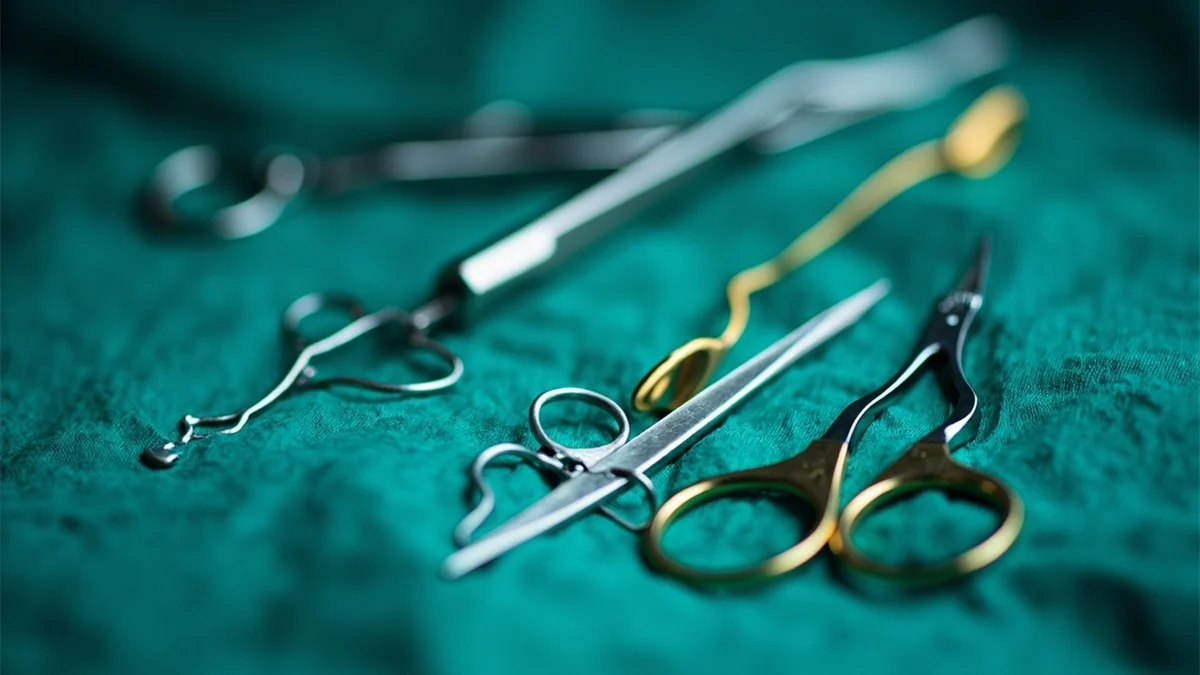
For high-volume surgical trays, upgrading needle holders and dissecting scissors to Tungsten Carbide (TC) inserts—identifiable by gold-plated finger rings—delivers the highest ROI in the operating theater. Brazed or laser-welded TC jaws achieve 68 to 72 HRC hardness, gripping 5-0 and 6-0 cardiovascular or plastic surgery needles with zero axial rotation across 1,500+ autoclave cycles.
Pair your surgical instrument investment with precision-finished clinical attire designed for 16-hour operating shifts: explore our antimicrobial scrubs and custom lab coats in /collections, browse /categories and /products (including the Onyx Black Scrub Set and Jet Black Scrub Set), and finalize clinic procurement via /checkout.
When drafting institutional tender specifications for surgical instrument sets, procurement teams should explicitly require mill test certificates (MTC 3.1 per EN 10204) verifying the melt chemistry of the AISI 420 or 316L bar stock, alongside digital Rockwell C hardness test reports and ASTM A967 citric/nitric passivation batch records from the manufacturer. This documentation eliminates low-cost grey-market substitutions before instruments ever enter the hospital CSSD.
Training CSSD technicians to segregate martensitic AISI 420 cutting instruments from austenitic 304/316L hollowware during ultrasonic washing—and banning chloride bleach solutions from instrument sinks—prevents galvanic and pitting corrosion across the entire surgical inventory.
Combining ISO 7153-1 material certification, ASTM A967 nitric or citric acid passivation verification, and routine neutral-pH enzymatic reprocessing ensures your surgical instrument trays deliver decades of corrosion-free mechanical precision across thousands of clinical procedures.
Direct Storefront Integration
Recommended Clinical Workwear & Institutional Ordering
Standardize staff barrier protection and clinical uniforms alongside your biomedical equipment procurement.
Explore Surgical & Clinical Collections
View all ZeruvMed clinical scrub sets and barrier lab coats for surgical teams.
Storefront Categories
Browse Women, Men, Lab Coats, and Premium designer clinical apparel.
All Clinical Products
Inspect fabric technology, sizing, and pricing across all 21 clinical SKUs.
Jet Black Scrub Set (Men)
Tailored V-neck surgical scrub set with 4-way stretch and antimicrobial finish.
Direct Clinic Checkout
Order clinical uniforms and lab coats with instant card, bank transfer, or COD.
Clinical Audit & Purchasing Q&A
Frequently Asked Questions
Why do Gold-Ring (Tungsten Carbide) needle holders cost more than standard stainless needle holders?
Gold-ring surgical instruments contain sintered Tungsten Carbide (TC) inserts bonded into the working jaws (or bonded along scissor blades). While a standard AISI 420 needle holder has a jaw hardness of 44–48 HRC that wears smooth after 300–400 cases, Tungsten Carbide reaches 68–72 HRC, preventing needle rotation and lasting 5 times longer before jaw replacement is needed.
What is the difference between brown staining and true red rust on autoclaved instruments?
A wipeable brown or rainbow film usually indicates baked-on blood protein (incomplete ultrasonic cleaning), high copper/iron content in autoclave feedwater, or alkaline detergent residue. True pitting corrosion (red/black cratering around box locks that cannot be polished off) results from chloride exposure (saline/bleach) or poor-quality unpassivated AISI 410/420 steel.
Can sodium hypochlorite (bleach) be used to soak stainless steel surgical instruments?
Never soak AISI 420 surgical instruments in sodium hypochlorite (bleach) or physiological saline (0.9% NaCl) for extended periods. Chloride ions aggressively breach the nanometer-thin Cr2O3 passive film on martensitic stainless steel, causing irreversible microscopic stress-corrosion cracking and pitting inside the box lock within 20 to 30 minutes.
What does CE Mark and ISO 7153-1 mean on a surgical instrument box?
ISO 7153-1 specifies the exact chemical composition and metallurgical grade required for each class of surgical instrument, while CE marking under EU MDR 2017/745 (Class I Reusable Surgical Instruments, Class Ir) requires Notified Body auditing of the manufacturer's cleaning, sterilization, passivation, and biocompatibility validation files.
How should new surgical instruments be processed before their first clinical use?
Brand-new instruments ship from the factory with a thin protective paraffin film and must never go straight into an autoclave. First wash them in warm water with a neutral-pH (7.0–8.5) detergent to strip shipping oils, rinse in demineralized water, lubricate box locks with water-soluble instrument milk, and run a full Class B sterilization cycle.
Continue Reading
Related Clinical Procurement Guides
Disposable vs Reusable Surgical Instruments
Analyze the 5-year Total Cost of Ownership (TCO), CSSD reprocessing labor, surgical site infection (SSI) risk, and hybrid kit strategies for disposable vs reusable surgical instruments.
Class B vs Class N vs Class S Autoclaves
Compare EN 13060 Class B fractionated pre-vacuum, Class S intermediate, and Class N gravity displacement autoclaves across hollow lumen penetration, Bowie-Dick testing, and 5-year clinic TCO.
Sterilization Pouches & Class 1–6 Indicators
Complete clinical guide to ISO 11140-1 Chemical Indicators (Type 1 to Type 6), EN 868-5 medical peel pouches, biological spore testing (ISO 11138), and event-related sterile shelf life.